Image analysis pipeline
Introduction
The petrographic polarising microscope is a foundational tool in geoscience research to answer first-order questions such as rock micro-structure, fabric, and mineral assemblage at multiple observation scales. The arrival of fast and reliable optical slide scanners for biomedical imaging has motivated their re-implementation as polarising microscopes for imaging rock thin sections. Investigators are now demanding sharing their slide data around the world via virtual microscopes, scaling up image analysis to hundreds of thin sections, and integrating optical imagery with other modalities, especially chemical maps.
The microscopy image analysis literature usually shows that studying small fields of view and targeting mineral grains and micro-structure (texture) with one microscopy technique is a challenging task. The human vision is much more effective at capturing large-area and correlative (more than one technique) patterns within the images than image analysis algorithms, therefore becoming the ground-truth for many of them. However, this is a time-consuming and non consistent exercise when there are a large number of items within the images (relative to the field of view). A new generation of image analysis requires algorithms that can cope with very large images (image pyramids) for alignment (registration), representation, segmentation, and classification of those items (objects or pixels). These tasks largely simplify the observation and management of the original data. Therefore, the availability of open-source software and open-access data together with adequate digital infrastructure are key for reaching the long-term goal of centralised data management, orchestration, and analysis from images and instruments that might not be locally available (the cloud) but are key to produce discoveries.
We contribute an image analysis workflow made of new software for image processing and analysis: Cube Converter, Chemistry Simplifier and Phase Interpreter. They work in concert with QuPath (Bankhead et al., 2017) and ImageJ (Schneider et al., 2012) open-source software for advanced image analysis. Segmentation has been demonstrated with the Pixel Classifier following the elaboration of multi-channel images with Image Combiner Warpy. The user-driven integration of optical reflected light (RL), PPL-max, and XPL-max only has provided results comparable to Scanning Electron Microscopy (SEM) Energy-dispersive X-ray Spectroscopy (EDX) and Automated mineralogy systems.
Optical scans where the mineralogy shows pleochroism and interference colour contrast that is more or less invariant to crystal orientation are the perfect use cases for optical phase maps (e.g., amphibolite, harzburgite). For most rocks, image stacks containing optical and SEM data for image segmentation are ideal to produce research-level phase maps with the trade-offs of all the involved techniques. The workflow below shows the type of microscopy data that can be involved in a given research project.
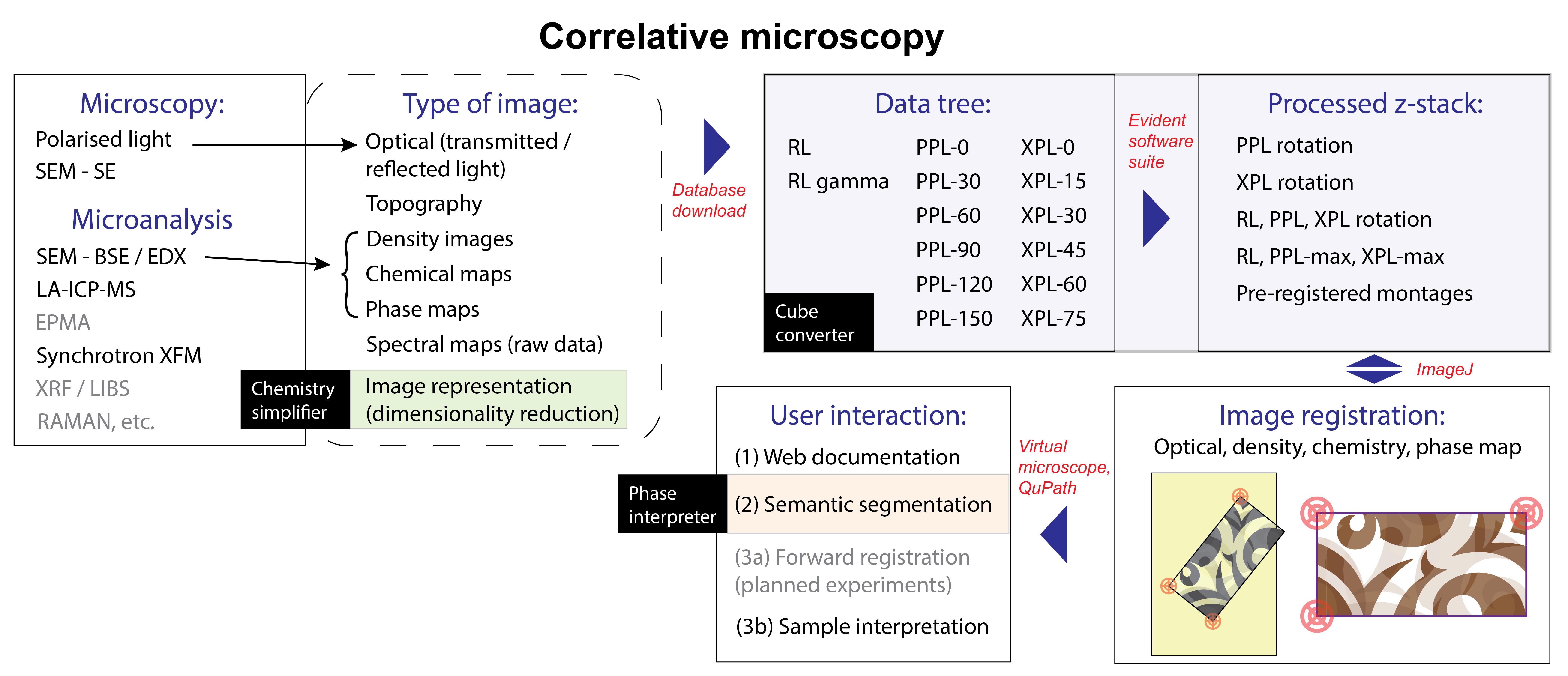
Figure 1: Microscopy techniques, workflow steps, and software involvement within a given research project on a thin section (blue= Cube Converter; green= Chemistry Simplifier; orange= Phase Interpreter). Imaging data flows between the software packages when a user manually perform data management and customises the image analysis pipeline outputs.
After learning how to do optical phase maps, you can add new dimensions to your analysis since polarised optical microscopy can be helpful for:
Mineral identification: phases of distinctive colours (Acevedo Zamora & Kamber, 2023), isochemical minerals,
Micro-structure: grains (properties), boundaries, contacts, neighbouring relationships (Kamber et al., 2025), and rock fabric
Fine micro-structure (e.g., diagenetic dykes), even if they are not shown in chemical maps (Acevedo Zamora et al., 2024)
Accessory phases and micro-inclusions using optical objective of high magnifications
Sample depth or volume using different focusing planes (extended depth of focus) (Marchant et al., 2020)
Mineral optic-axis and/or slow-axis orientation (Acevedo Zamora et al., 2024)
Sample preparation quality and thickness (e.g., showed in XPL interference color variations)
Experimental planing as data acquisition requires choosing the location of micro-analytical spots (’forward registration’) (Acevedo Zamora et al., 2026)
An extended introduction and discussion on the image analysis pipelines motivations and software can be seen in a doctoral thesis. The main developer of this ongoing project is Marco Acevedo who extends the invitation to new developers of new and equally exiting applications.
Software installers
The latest versions of the software can be downloaded into a personal computer (PC). Software developers might also want to download the source code for forking and/or improving the software. The links are:
Internal (new) software
Cube Converter v1.2: Windows 11 EXE, Source code
Chemistry Simplifier v1.2: Windows 11 EXE, Source code
Phase Interpreter v2: Windows 11 EXE, Source code
External software
QuPath v0.7: App, Source code, Documentation
ImageJ Fiji: App, Documentation
Scientific citations
The software depends on open-source libraries, increasing numbers of scientific citations and user feedback if we want to keep it free. The following research papers need to be cited if using the software:
Cube Converter:
Acevedo Zamora, M. A., & Kamber, B. S. (2023). Petrographic Microscopy with Ray Tracing and Segmentation from Multi-Angle Polarisation Whole-Slide Images. Minerals, 13(2), 156. https://doi.org/10.3390/min13020156
Acevedo Zamora, M. A., Schrank, C. E., & Kamber, B. S. (2024). Using the traditional microscope for mineral grain orientation determination: A prototype image analysis pipeline for optic-axis mapping (POAM). Journal of Microscopy, 295(2), 147-176. https://doi.org/10.1111/jmi.13284
Chemistry Simplifier:
Acevedo Zamora, M. A., Kamber, B. S., Jones, M. W. M., Schrank, C. E., Ryan, C. G., Howard, D. L., Paterson, D. J., Ubide, T., & Murphy, D. T. (2024). Tracking element-mineral associations with unsupervised learning and dimensionality reduction in chemical and optical image stacks of thin sections. Chemical Geology, 650, 121997. https://doi.org/10.1016/j.chemgeo.2024.121997
Phase Interpreter:
Acevedo Zamora, M. A., & Kamber, B. S. (2023). Petrographic Microscopy with Ray Tracing and Segmentation from Multi-Angle Polarisation Whole-Slide Images. Minerals, 13(2), 156. https://doi.org/10.3390/min13020156
Acevedo Zamora, M. A., Kamber, B. S., Jones, M. W. M., Schrank, C. E., Ryan, C. G., Howard, D. L., Paterson, D. J., Ubide, T., & Murphy, D. T. (2024). Tracking element-mineral associations with unsupervised learning and dimensionality reduction in chemical and optical image stacks of thin sections. Chemical Geology, 650, 121997. https://doi.org/10.1016/j.chemgeo.2024.121997
Kamber, B. S., Acevedo Zamora, M. A., Rodrigues, R. F., Li, M., Yaxley, G. M., & Ng, M. (2025). Exploring High PT Experimental Charges Through the Lens of Phase Maps. Minerals, 15(4), 355. https://doi.org/10.3390/min15040355
Specific software and libraries were used to write the programs. Go to the GitHub pages to linked to their original citations. In addition, the geoscience papers below contributed as collaboration projects that engaged people and evolved the software:
Chemistry Simplifier:
Ubide, T., Murphy, D. T., Emo, R. B., Jones, M. W. M., Acevedo Zamora, M. A., & Kamber, B. S. (2025). Early pyroxene crystallisation deep below mid-ocean ridges. Earth and Planetary Science Letters, 663, 119423. https://doi.org/10.1016/j.epsl.2025.119423
Phase Interpreter:
Rodrigues, R. F., Yaxley, G. M., & Kamber, B. S. (2025). Phase relations and solidus temperature of garnet lherzolite at 5 GPa revisited. Contributions to Mineralogy and Petrology, 180(9), 57. https://doi.org/10.1007/s00410-025-02250-4
The software pipeline evolved to be user-friendly thanks to AuScope (NCRIS Opportunity Fund). The fund contributed to finance Marco’s postdoc. In addition, the Geological Survey of Queensland (GSQ) is acknowledge for the financing an ongoing research project to document and study Queensland mineral deposits that has allowed further software updates. We encourage advanced sample documentation using the QUT rock virtual microscope .